India: Evidence in Red Fort Explosion Reveals Links to Islamic Jihad Terror Network Behind the Deadly Strike
- Mahamunimodi Team
- Nov 12, 2025
- 3 min read
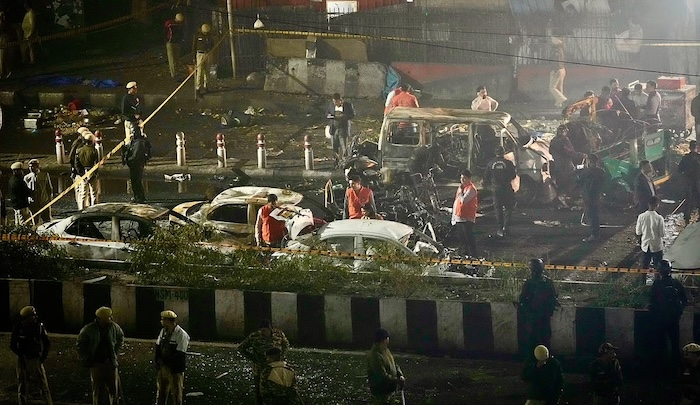
A powerful explosion that ripped through the vicinity of Delhi’s Red Fort on November 10, 2025, has once again exposed a grim truth — Islamic terrorism may have appeared dormant for a time, but it has not disappeared from Indian soil. The evening blast, which erupted near the Sunehri Masjid parking area around 6:52 p.m., claimed at least twelve lives and left twenty others grievously injured, including women and children. The toll is feared to rise as several victims battle for their lives in hospitals across the capital. The deafening explosion triggered a massive blaze, consuming nearby vehicles and shattering glass windows across the densely packed Mughal-era lanes. Within minutes, firefighters, paramedics, and rescue personnel swarmed the area, pulling victims from burning cars and ferrying the wounded to various trauma centers.
Preliminary investigations have traced the origin of the blast to a white Hyundai i20, registered in Haryana under the number HR26CE7674. CCTV footage captured a masked man parking the car near the mosque nearly three hours before the explosion and walking away just minutes before it detonated — a critical lead now driving the ongoing probe. The trail of ownership led police deep into Jammu and Kashmir, where the car was first registered under the name of Mohd Salman, who was detained in Gurugram. Salman allegedly sold the vehicle to Tariq, a Pulwama resident now under scrutiny for his suspected role in the attack. Interrogations are focused on whether Tariq acted independently or as part of a broader terror network that transported the explosives into Delhi. The car dealer involved in the transaction has also been taken into custody for questioning.
Among the key suspects is Dr. Mohammad Umar — also known as Umar Mohammad — a Pulwama-based doctor previously linked to a Jaish-e-Mohammed (JeM) module dismantled in Faridabad. Authorities suspect Umar might have been in the vehicle at the time of the explosion, raising the possibility that this was a suicide bombing. His mother and two brothers have been detained for interrogation, and DNA samples from their family are being cross-matched with remains found at the site to confirm his identity.
Investigators believe the Red Fort blast may not be an isolated incident but rather an extension of a sophisticated terror network of “white-collar jihadists,” involving educated professionals — doctors, professors, and engineers — covertly aiding militant operations. This same network came under the radar earlier when two doctors from Jammu and Kashmir — Dr. Adil Ahmad Rather and Dr. Muzammil Ahmad Ganaie — were arrested for supplying explosives and recruiting operatives for JeM’s northern India operations. Both were apprehended from Uttar Pradesh and Haryana, respectively, during a major crackdown earlier this year.
Another name now surfacing in the Red Fort probe is that of Dr. Shaheen Sayeed, a faculty member at Al-Falah University in Faridabad. She is believed to have been involved in creating a women’s recruitment wing for Jaish-e-Mohammed. Her link with Dr. Umar — both being associated with the same university — has strengthened suspicions that the Red Fort bombing could be the work of an interlinked professional-terror network using academic institutions as operational fronts.
The Delhi Police Special Cell and the National Investigation Agency (NIA) are jointly spearheading the probe, deploying bomb experts, forensic specialists, and digital analysts. Initial examinations indicate the use of a high-intensity explosive, possibly RDX or an advanced incendiary mix, though official confirmation awaits forensic results. Investigators are also analyzing electronic data — GPS logs, mobile signals, and money transfers — to uncover the route and communication trail of those involved.
In response, Delhi and neighboring states have been placed under a state of high alert. Security has been tightened across airports, metro stations, religious places, and key government installations. Police patrols have intensified in Delhi, Haryana, and Uttar Pradesh, while intelligence units are coordinating nationwide to detect possible sleeper cells.
The Red Fort blast has reignited fears of an organized revival of Islamic terror cells within India’s urban centers, driven by educated radicals and foreign-inspired ideologies. With several arrests made and new connections surfacing by the day, investigators are racing against time to dismantle the wider network behind the attack. The explosion, striking so close to one of India’s most iconic heritage sites, serves as a chilling reminder that the battle against terror — though quieter in recent years — is far from over.


Comments