Silenced for Speaking Truth: The Ordeal of Bangladeshi Hindu Journalist Trina Roy Choudhury
- Mahamunimodi Team
- Nov 10, 2025
- 4 min read
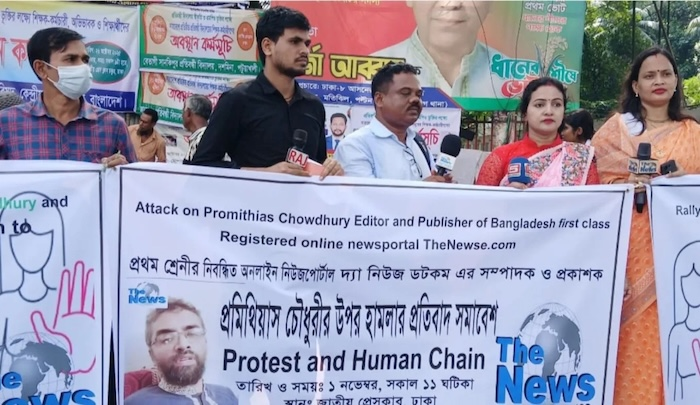
Towards the end of October 2025, Bangladesh once again found itself confronting the chilling reality of what it means to be a minority voice in a Muslim-majority nation. Trina Roy Choudhury, a courageous Hindu journalist renowned for her investigative reporting on violence against minorities, became the latest target of a brutal campaign of intimidation and threats. Her ordeal, marked by physical assault, explicit threats of sexual violence, and institutional apathy, exposes the grave risks that journalists—and particularly those from minority communities—face in today’s Bangladesh.
The Assault and the Threats
On October 29, 2025, Trina’s husband, Promithias Chowdhury, was violently attacked at a local shop in Barishal, allegedly owned by a man named Nazim Mulla. Shockingly, Mulla had been a friend of Promithias. Yet, in the heat of the assault, friendship and humanity gave way to religious hatred. As Trina recounted to Indian outlet OpIndia, when Promithias reminded his assailants of their past friendship, they spat back venomously:
“You are a kafir Hindu, how can you be a friend? Bangladesh belongs to us; we let you stay here out of mercy. Get out of Bangladesh.”
Simultaneously, Trina herself received horrifying threats of sexual violence, including messages that a Muslim gang would “gang-rape” her as punishment for her reporting. These words were not idle threats—they were clear instruments of terror, meant to silence her voice and break her spirit.
The Price of Truth
Roy’s investigative work, published in The News, had focused on sensitive yet vital issues: attacks on Hindu communities, desecration of temples, forced conversions, and mob violence targeting minorities across Bangladesh. Her fearless reporting unsettled local Islamist groups who saw her documentation of these atrocities as a direct challenge to their ideological dominance.
In the hours following the assault, her newsroom was flooded with anonymous calls and online messages demanding she stop publishing what they called “anti-Muslim” or “anti-Islam” content. The threats escalated further when her personal details—and even a video of her husband’s assault—were circulated on social media, an act clearly intended to terrorize not only her but every journalist daring to expose the persecution of minorities.
Institutional Apathy and Police Inaction
Even more disturbing than the threats themselves was the response—or lack thereof—by law enforcement. Despite multiple pleas, the local police allegedly refused to file a First Information Report (FIR). Instead, according to Trina and her husband, officers threatened to register counter-cases accusing them of “inciting communal unrest.” Such behavior, they claimed, reflected a deep-seated bias and fear of confronting Islamist extremists, some of whom were believed to have ties to jihadist organizations.
This institutional inaction mirrors a broader pattern in Bangladesh’s handling of violence against minorities: a culture of denial, complicity, and systemic neglect that emboldens perpetrators and silences victims.
Echoes of the Past: The Ghost of Avijit Roy
The attack on Trina and her husband evokes haunting parallels with the 2015 murder of Avijit Roy, the Bangladeshi-American writer and secular activist. Roy, born into a Hindu family and founder of the rationalist platform Mukto-Mona, was hacked to death with machetes outside a Dhaka book fair by Islamist extremists. His wife, Rafida Ahmed, barely survived, losing two fingers in the attack. Witnesses later recounted that police stood just meters away but refused to intervene—a grim testament to the state’s fear of confronting religious fundamentalism.
A decade later, Bangladesh seems to be reliving the same nightmare. The same silence, the same impunity, the same chilling message: that secular voices and minority journalists are expendable.
Silence of the Press and the World
On November 3, 2025, Bangladeshi journalist associations organized a human chain protest outside the Barisal Press Club, demanding justice and the arrest of the perpetrators. Yet, even as the case gained local attention, mainstream Bangladeshi media chose to remain silent. No arrests have been reported, and no formal investigation updates have been made public.
This silence extends beyond Bangladesh’s borders. Despite the gravity of the case—a Hindu woman journalist threatened with gang-rape for her reporting—neither international media outlets nor global press freedom organizations have issued statements of condemnation. Groups that routinely mobilize for journalists under threat elsewhere have remained conspicuously quiet. Feminist collectives that speak passionately about gendered violence in journalism have, in this case, looked the other way.
Selective Outrage and the Hypocrisy of Global Advocacy
This selective silence reveals a disturbing hypocrisy. When journalists or activists from Muslim backgrounds face discrimination, international organizations rush to issue statements, hold conferences, and amplify their voices. But when the victims are non-Muslims—especially Hindus or secular critics of Islamist extremism—the global machinery of outrage falls eerily silent.
The indifference toward Trina Roy Choudhury’s ordeal exposes how press freedom and women’s rights are defended selectively, shaped not by universal principles but by ideological convenience. The silence of liberal agencies, rights groups, and major media houses underscores a grim truth: when the oppressors are Muslim and the victims are Hindu, the narrative ceases to be newsworthy.
Conclusion
The threats against Trina Roy Choudhury and the assault on her husband are not isolated acts of communal hatred—they are part of a broader pattern of persecution faced by Bangladesh’s Hindu minority and those who dare to document it. The failure of the state to protect her, the media’s silence, and the world’s indifference together form a dangerous alliance of neglect.
Bangladesh stands at a crossroads once again, confronting the same forces of intolerance that silenced Avijit Roy a decade ago. And unless the world breaks its silence now, it risks watching history repeat itself—with another journalist’s courage crushed under the weight of global hypocrisy.


Comments