Islamic Texts, Historical Interpretations and the Ideological Claims Surrounding October 7
Debates over Islamist terrorism often begin with the question of whether the ideology behind modern extremist violence has any connection to Islam’s earliest sources. Supporters of the continuity argument point to the Sirah, hadith collections and Qur’anic verses that describe warfare, relations with non-Muslims, apostasy and political authority. Critics, including many Muslim scholars, argue that these passages must be understood through their historical circumstances and that extremist groups selectively interpret them. The distinction matters: the existence of violent passages or historical episodes does not by itself establish that all Muslims, or Islam as a whole, endorse modern terrorism.
Warfare in the Early Islamic Tradition
Early biographies of Muhammad describe a transition from the preaching phase in Mecca to an armed political community in Medina. Ibn Ishaq's Sirat Rasul Allah, preserved in later versions including the recension associated with Ibn Hisham, records that permission to fight came after the migration to Medina. Qur'an 22:39–41 is traditionally understood as an early authorization for fighting those who had been wronged, while later passages contain broader rules concerning warfare.
Other verses became central to classical discussions of warfare. Qur'an 2:193 speaks of fighting until fitna is ended and religion is for Allah, while Qur'an 9:5 contains the well-known command concerning fighting polytheists after the sacred months. Classical Muslim commentators developed different interpretations of these passages, including arguments about their historical circumstances, treaties and the circumstances under which the verses applied.
These passages therefore form an important part of the historical record, but their interpretation is contested. Modern jihadist organizations generally emphasize the most militant readings while rejecting interpretations that restrict such verses to their original historical setting.
Jews, Christians and the Question of Political Submission
The early Islamic historical tradition also contains accounts of conflict between Muhammad's community and several Jewish tribes in Medina. The episodes involving Banu Qaynuqa, Banu Nadir and Banu Qurayza have been extensively discussed by Muslim and non-Muslim historians, although details and interpretations differ between sources.
Accounts concerning individuals such as Ka'b ibn al-Ashraf and Abu 'Afak have likewise been used in arguments about whether early Islamic political authority permitted targeted violence against opponents. Because the principal biographies were compiled generations after Muhammad, historians also examine their transmission, chronology and reliability rather than treating every narrative detail as equally certain.
Qur'an 9:29 is another frequently cited passage. It instructs Muslims to fight certain members of the People of the Book until they pay jizya. Classical Islamic jurisprudence subsequently developed rules concerning non-Muslim communities living under Muslim political authority. The historical dhimma system and the meaning of jizya, however, have been interpreted differently across periods and schools of Islamic law.
Apostasy and Classical Islamic Law
Apostasy represents another major point of debate. Sahih al-Bukhari contains reports attributed to Muhammad stating that a Muslim who leaves Islam may be subject to execution under specified circumstances. Classical Islamic jurists consequently developed rules concerning ridda, although the precise legal conditions and the relationship between apostasy, rebellion and treason varied among legal schools.
Modern Muslim scholars have challenged the application of classical apostasy laws to contemporary states, arguing that religious belief should not be criminalized or that the relevant hadiths concerned political rebellion rather than private belief. Nevertheless, extremist organizations have repeatedly invoked traditional apostasy rulings to justify violence against Muslims whom they label unbelievers.
From Historical Texts to Modern Islamist Ideology
The ideological connection claimed by modern jihadist organizations is therefore more specific than simply saying that terrorism is "Islamic." Groups such as al-Qaeda, ISIS and Hamas have used Islamic scripture, historical narratives and concepts of jihad to justify particular political and military actions. Their interpretations are rejected by many Muslim scholars and communities, but their own statements and propaganda demonstrate that they consciously present their actions through an Islamic ideological framework.
The important question is consequently not whether every Muslim accepts the same interpretation. The relevant question is how particular militant movements interpret selected religious texts and historical precedents, and how those interpretations are transformed into political violence.
October 7, 2023: Hamas and the Attack on Israel
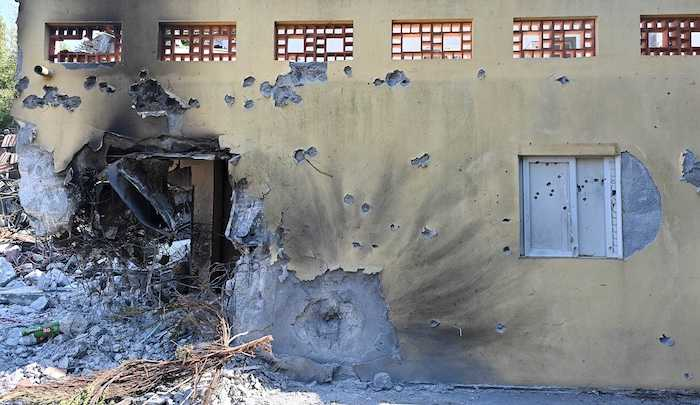
This debate became especially prominent after the Hamas-led attack on Israel on October 7, 2023. The assault began at approximately 6:30 a.m. under cover of a large rocket barrage. Hamas and other Palestinian armed groups crossed the Gaza perimeter by land, sea and air and attacked Israeli communities, military positions, roads and the Nova music festival.
United Nations investigations have documented the scale of the attack. More than 1,200 people were killed, and 251 people were abducted and taken to Gaza as hostages. The victims included civilians, children, elderly people, security personnel and foreign nationals.
The UN Commission of Inquiry documented people being shot, killed in shelters, burned in homes and attacked while attempting to flee. It also documented hostage-taking, mutilation of bodies and the destruction and looting of civilian property.
The United Nations has also investigated allegations of sexual violence. A UN mission found reasonable grounds to believe that sexual violence, including rape and gang rape, occurred at several locations during the October 7 attacks. A later UN report said these findings were corroborated by the UN Commission of Inquiry. The same reporting documented sexual and gender-based violence against some hostages during captivity in Gaza.
The Hostages and the Human Cost
The hostage-taking was a central element of the October 7 attack. According to the UN Commission of Inquiry, 251 people were abducted from Israel and taken to Gaza, including women, children, elderly people and foreign nationals. The commission also documented the holding of hostages incommunicado and the absence of reliable information about their condition.
Families were separated, communities were devastated and many survivors were left with severe physical and psychological injuries. The attack was not limited to military targets; civilians were deliberately attacked in homes, communities, roads and at a music festival. The UN Secretary-General has described the October 7 assault as a large-scale terrorist attack in which civilians were deliberately targeted and 251 people were abducted.
Questions Surrounding UNRWA Personnel
The involvement of UNRWA personnel has also been investigated. In 2024, allegations were made that 19 UNRWA employees in Gaza had participated in the October 7 attacks. The UN Office of Internal Oversight Services investigated the allegations. Its findings concluded that evidence in nine cases, if authenticated and corroborated, could indicate involvement, while evidence was insufficient in other cases. UNRWA subsequently terminated the contracts of the nine employees concerned.
That distinction is important. The investigation did not establish that all 19 accused employees participated in the attacks, nor did it establish that UNRWA as an institution participated in them. What it did establish was that serious allegations were investigated and that nine employees were removed after the investigation found potentially significant evidence against them.
The Ideological Question
The ideological debate surrounding October 7 cannot be settled simply by listing violent Qur'anic verses or early historical accounts. Nor can it be settled by claiming that modern jihadist violence has no relationship whatsoever to Islamic sources. The historical record contains passages and episodes concerning warfare, political authority, relations with non-Muslims and apostasy that militant movements have repeatedly cited.
At the same time, those sources have been interpreted in substantially different ways throughout Islamic history. Contemporary Muslim scholars and communities overwhelmingly reject the deliberate targeting of civilians, and modern extremist organizations represent particular ideological interpretations rather than a unanimous Muslim position.
What can be established more clearly is that Hamas and other Islamist militant organizations have deliberately framed their actions through Islamic religious and historical language. The October 7 attack itself, meanwhile, is extensively documented as an assault involving the deliberate killing of civilians, hostage-taking and other serious violations.
The most useful historical examination, therefore, is not to collapse Islam, Muslims and jihadist organizations into a single category. It is to examine precisely which texts and historical precedents militant organizations invoke, how those sources were interpreted in their original contexts, how classical jurists understood them, and how modern groups such as Hamas reinterpret them to justify political violence.


Comments